
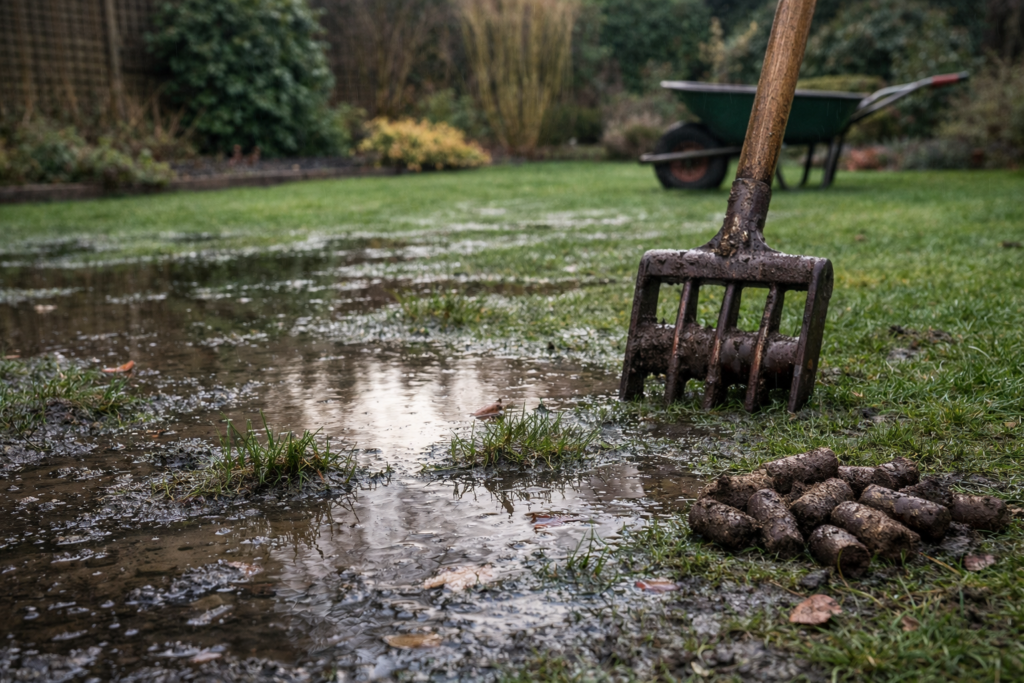
| Sodden Ground, Slow Decisions There’s a particular sound a lawn makes when it has taken on more water than it knows what to do with. Not the splash of a puddle, but a muted, reluctant squelch — as if the ground itself is sighing under your weight. You feel it before you see it. The grass still looks green enough, sometimes deceptively so, but the soil underneath has lost its firmness, its structure, its sense of direction. This is usually the moment a client asks about aeration. It’s a reasonable question. Aeration has become one of those ideas that floats around gardening conversations like a universal remedy: if the lawn is tired, spike it; if it’s wet, spike it; if it’s struggling, spike it. The trouble is that sodden lawns don’t respond well to impatience, even when that impatience is dressed up as good practice. What weeks of rain really do is strip away our illusions about control. They remind us that soil is not a surface but a system — one that responds slowly, remembers pressure, and rarely appreciates being interfered with at the wrong moment. When Water Stops Moving A lawn doesn’t usually become waterlogged because of rain alone. Rain is just the trigger. The real story is happening beneath the grass, in the spaces between soil particles — or more accurately, in the absence of those spaces. Healthy soil contains as much water as it does. In a balanced structure, rainfall arrives, passes through, and drains away, leaving behind moisture but not saturation. In compacted soil — often clay, but not exclusively — those air pockets have been squeezed out over time. Foot traffic, mowing, machinery, and even well-intended maintenance all press the soil tighter and tighter until water has nowhere to go. When that happens, the soil doesn’t drain; it holds. Roots sit in cold, airless ground. Microbial activity slows. Worms retreat. The lawn isn’t drowning in a dramatic sense, but it is being quietly deprived of oxygen. This is why sodden lawns feel lifeless underfoot, even when they look fine on the surface. The instinct, understandably, is to punch holes into the problem. The Aeration Paradox Aeration is meant to create space. The paradox is that, done at the wrong time, it does the opposite. If the soil is fully saturated, any hole made with a solid spike is prone to collapse almost immediately. Instead of opening a channel for air and water, the sides of the hole smear and compress, sealing themselves shut. In heavy ground, repeated spiking during wet spells can actually increase compaction below the surface, forming a denser layer that water struggles to penetrate later. This is one of those truths that doesn’t photograph well and doesn’t sell services easily, which is probably why it’s often skipped over. But experienced gardeners learn it the slow way: by seeing lawns worsen after enthusiastic winter spiking, not improve. Hollow-tine aeration avoids some of this by removing plugs of soil rather than pushing them aside, but even hollow tines need the ground to offer a little resistance. If the soil is so wet that plugs smear, deform, or collapse back into the hole, the benefit is limited. Timing matters more than tool choice. Waiting as an Active Skill There’s a cultural discomfort with waiting, especially when something looks wrong. A sodden lawn looks neglected, even when it isn’t. The temptation is to demonstrate care through action. In practice, the most professional response to prolonged rain is often restraint. Staying off the lawn. Redirecting foot traffic and letting the surface dry just enough for the soil to regain coherence. These aren’t passive choices; they’re informed ones. They require observation, patience, and a willingness to explain to clients that a delay is sometimes an intervention improved. Two consecutive dry days can change everything. Not because the lawn magically heals in forty-eight hours, but because the soil begins to drain under its own weight. Pore spaces reopen. The ground stops flowing under pressure and starts fracturing again. That subtle shift — from smear to crumble — is the difference between aeration that helps and aeration that harms. The Myth of the Perfect Moment Gardeners often talk about “the right time” to aerate as if it were a date in the diary. In reality, it’s a condition, not a calendar slot. Spring can be too wet. Autumn can be too wet. Winter can occasionally offer a surprisingly suitable window. The soil decides, not the season. This is why experienced gardeners press their heel into the turf before reaching for tools. If the ground deforms plastically — smooth, shiny, smeared — it isn’t ready. If it breaks with a dull crack and shows structure, it’s probably. One of the quieter myths around lawn care is that more frequent aeration is always better. In truth, unnecessary aeration can disturb root systems, encourage weed ingress, and create expectations that soil can be endlessly corrected from the surface. Long-term improvement usually comes from fewer, better-timed interventions, paired with changes in how the lawn is used. Lawns as Social Spaces Most compaction isn’t caused by neglect; it’s caused by living. Dogs pacing the same route. Children cutting corners. Gardeners walking predictable lines with mowers. Gates, sheds, and washing lines — all concentrate pressure. Sodden lawns expose these patterns brutally. The wettest patches are rarely random. They map movement and habit more accurately than any survey. This is why some lawns never fully recover, no matter how often they’re aerated. The soil is being asked to perform against the grain of daily life. Sometimes the most honest long-term solution isn’t better aeration but a conversation about paths, stepping stones, or allowing certain areas to stop being lawn altogether. That can feel like defeat if you’re attached to uniform green, but it’s often a form of care, choosing resilience over appearance. Aeration as Part of a Bigger Story When aeration does happen at the right time, its effects are subtle rather than dramatic. There’s no overnight transformation. The lawn doesn’t suddenly drain like gravel. What changes is the soil’s willingness to recover. Roots explore deeper. Worms return. Water lingers less aggressively after rain. The lawn becomes more forgiving of weather extremes — not immune, but less fragile. This is the kind of progress that’s easy to miss if you’re looking for quick results, but impossible to ignore over the years. Top-dressing after aeration can support this process, but only when the materials are carefully selected. Compost alone can hold moisture in already wet soils. Sharp sand alone can create layers. Blended, appropriate dressings applied lightly and brushed in patiently tend to work best, though even then they’re a nudge, not a fix. Living With Winter Lawns There’s a seasonal humility required in British gardening. Our winters are rarely kind to lawns, and increasingly they’re wetter than many turf traditions were designed for. Expecting lawns to look crisp and resilient during prolonged rainfall is a mismatch between expectations and climate. A sodden winter lawn isn’t a failure. It’s a pause. The grass slows. The soil closes ranks. Recovery doesn’t begin the moment rain stops; it begins when temperatures rise, roots wake, and biological processes resume. Aeration supports recovery only if it respects the lawn’s timing. One of the quieter pleasures of working with gardens year after year is learning to recognise these pauses without panic. To see saturation not as damage but as a condition to be managed. To understand that some seasons are about protection rather than improvement. Knowing When to Step In The best time to aerate a lawn is not when it looks worst, but when it’s ready to respond. That readiness shows itself in feel rather than appearance. Underfoot, in the sound of soil, in how quickly footprints fade. This kind of judgment can’t be rushed or automated. It comes from watching many lawns fail and recover in their own ways. From learning that good gardening often looks like doing less, but doing it well. Sodden lawns test patience — ours as much as our clients’. They ask us to explain invisible processes and defend slow decisions. But they also offer clarity. They remind us that soil health is cumulative, that structure matters more than surface, and that timing is a form of respect. In the end, aeration isn’t a solution to wet weather. It’s a conversation with the soil — one that only works when the soil is ready to answer. Sodden Lawns & Aeration — A Quick Guide Is my lawn damaged because it’s waterlogged? Usually not. Most lawns cope with short-term saturation. Problems arise when wet conditions persist, and the soil becomes compacted or regularly walked on. Should we aerate straight away while it’s wet? No. Aerating saturated ground can smear and compress the soil, closing air spaces rather than opening them. Waiting almost always leads to a better result. How do you know when the time is right to aerate? When the ground has firmed up enough to crumble rather than smear underfoot. This often follows a couple of dry days, but it’s about soil condition, not the calendar. Will walking on the lawn make it worse? Yes. Foot traffic on wet ground is a major cause of compaction. Where possible, staying off the lawn allows it to recover naturally. Is spiking or hollow-tine aeration better? Hollow-tine aeration is generally more effective for compacted or clay soils, but only when conditions allow. Tool choice matters less than timing. Should we reseed or feed a sodden lawn? Not usually. Seed struggles in saturated soil, and feeds can wash away or stress the grass. Recovery is better supported once drainage and air flow improve. Why does this happen every winter? Often it’s a combination of soil type, compaction, and how the lawn is used. Repeated winter wetness may point to a longer-term drainage or design issue. What’s the most helpful thing we can do right now? Patience. Allow excess water to disperse, minimise traffic, and intervene only once the lawn can respond — not before. |
| About our writing & imagery Most articles reflect our real gardening experience and reflection. Some use AI in drafting or research, but never for voice or authority. Featured images may show our photos, original AI-generated visuals, or, where stated, credited images shared by others. All content is shaped and edited by Earthly Comforts, expressing our own views. |